
1. Introduction to Flexible HVDC Transmission
As a new generation of DC transmission technology, flexible HVDC transmission has been widely developed and applied worldwide. Domestically, in 2014, the five-terminal flexible HVDC transmission project was completed in Zhoushan, Zhejiang, using 200kV DC voltage and a multi-terminal flexible HVDC transmission system that can carry clean energy from multiple stations. In 2015, the Xiamen Flexible HVDC Transmission Technology Demonstration Project was completed and put into operation, raising the voltage level to 320kV for the first time, marking that China has fully mastered the design, construction, and operation capabilities of high-voltage large-capacity flexible HVDC transmission projects. In December 2016, construction of the Chongqing-Hubei flexible HVDC back-to-back interconnection project was initiated. It is currently the project with the highest voltage level (420kV) and largest scale in the world.
2. Bypass Thyristor Application Conditions
Modular Multilevel Converters (MMC) are widely used in the field of high-voltage large-capacity flexible HVDC transmission due to their modular design and scalability. The application of bypass thyristors in MMC sub-modules is shown in the following figure:
Under DC pole line short-circuit faults in flexible HVDC systems, Fast Recovery Diodes (FRD) withstand short-circuit currents for long periods. Bypass thyristors are required for shunt protection to prevent the entire converter valve from overheating and burning out. Under this application condition, there are two main requirements for bypass thyristor applications: First, rapid conduction. Since the turn-on voltage of the bypass thyristor is the tube voltage drop of the FRD, combined with the U-I characteristic curve of the FRD, the conduction voltage of the bypass thyristor is required to be as small as possible. Second, rapid expansion. After the bypass thyristor is turned on, the shunt ratio with the FRD must be greater than 80%, requiring the conduction voltage drop of the bypass thyristor to be very low.
3. Bypass Thyristor Process Optimization
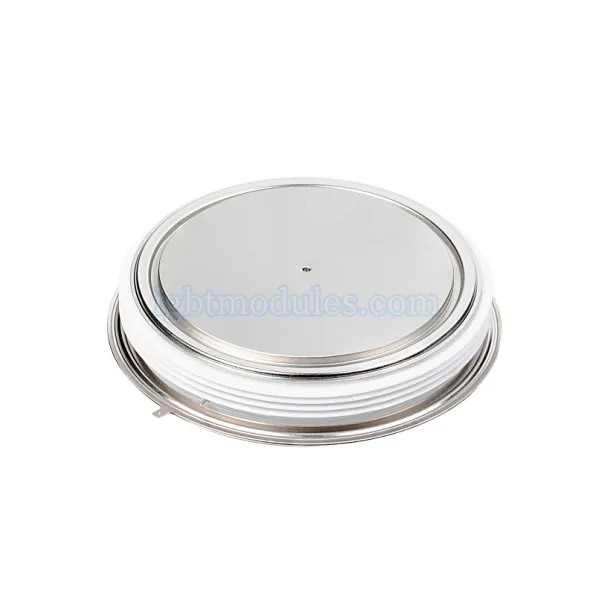
Based on 50 years of professional high-power semiconductor device design experience, combined with the application requirements of HVDC transmission and flexible HVDC transmission projects, CRRC Times Semiconductor has demonstrated various schemes for parameters such as silicon wafer thickness, resistivity, and crystal orientation through computer simulation platforms, selecting the optimal silicon wafer scheme. Using internationally advanced high-precision diffusion systems, process optimization improves diffusion uniformity and enhances device dynamic performance. Through vertical process parameter optimization, the electron injection ratio during conduction is increased, enhancing the long-base conductivity modulation effect, effectively reducing base region conduction resistance, and reducing the thyristor conduction voltage drop. Using simulation software such as ANSYS for thermal simulation analysis of thyristors, the structure of the heat dissipation channel is optimized, and the optimal technical solutions for the package and molybdenum sheet are selected to reduce device thermal resistance. Research on the internal temperature distribution of large-size thyristors and optimization of temperature field distribution design avoids local overheating under high current conditions, improving short-circuit current withstand capability.
4. Bypass Thyristor Application Effects
The series of thyristors manufactured by CRRC Times Semiconductor have been applied in batches in Nanhui, Zhoushan, Nan’ao, Xiamen, and the Chongqing-Hubei flexible HVDC projects. The bypass thyristor KPB 3200-34 (3200A/3400V) used in the Chongqing-Hubei flexible HVDC back-to-back interconnection project has a turn-on shunt ratio greater than 80% under real fault current conditions.
Combined with the gate trigger requirements in flexible HVDC transmission systems, a low-voltage turn-on test method for bypass thyristors using DC power supply was developed in Zhuzhou. Taking the bypass thyristor KPB3200-34 used in the Chongqing-Hubei project as an example, through quantitative analysis of heat generation and expansion area of different currents on the thyristor chip, a quick and effective test method for the minimum turn-on voltage for full expansion of bypass thyristors was obtained. All bypass thyristors are tested and screened for minimum turn-on voltage according to system requirements.
Conclusion
CRRC Times Semiconductor bypass thyristors are widely used in multiple flexible HVDC transmission systems such as Nanhui, Zhoushan, Nan’ao, Xiamen, and Chongqing-Hubei, with good application results. Currently, the company is actively cooperating with the construction of the State Grid Zhangbei Ring Network Flexible HVDC Transmission System.
CRRC Times Semiconductor has a China-Europe joint power semiconductor device R&D center, power semiconductor device simulation technology and manufacturing equipment, as well as a complete power semiconductor device testing platform. CRRC manufacturing will help promote the development of flexible HVDC transmission technology.