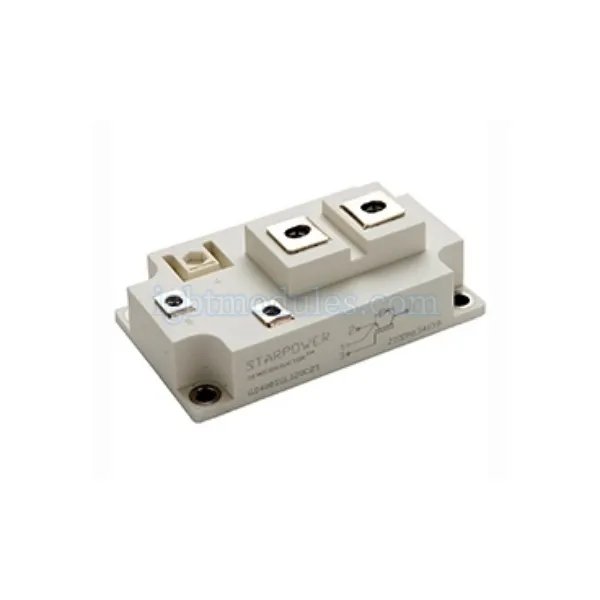
1. Thyristor Product Family
Voltage ratings: 400V to 6500V; Current ratings: 10A to 3000A; Stud, disc, and module packages; Phase-control and inverter-grade types; Gate-triggered latching operation
2. Package Types
Different mechanical packages accommodate varying power levels and thermal management approaches.
Comparison Table
| Package | Voltage Range | Current Range | Cooling Method |
|---|---|---|---|
| Stud Type | 400V – 2500V | 10A – 500A | Single-sided |
| Disc / Hockey-Puck | 1200V – 6500V | 200A – 3000A | Double-sided |
| Module Package | 600V – 1800V | 25A – 200A | Baseplate cooled |
| Surface Mount | 400V – 800V | 4A – 40A | PCB / heatsink |
Stud-Type Thyristors
Stud-mounted packages provide a threaded stud for direct heatsink mounting.
• Current range: 10A to 500A; Simple single-screw mounting; Isolated and non-isolated options; Cost-effective for medium power
Disc (Hockey-Puck) Thyristors
Disc-type thyristors offer double-sided cooling for the highest power ratings.
• Current range: 200A to 3000A+; Excellent thermal performance; Press-pack assembly; Used in HVDC and traction systems
3. Application Areas
Thyristors excel in applications requiring high power handling with phase-control or rectification.
Power Control
Phase-angle control enables precise regulation of power delivery to resistive and inductive loads.
• Industrial heating controls; Light dimming systems; Motor soft-starters; Welding power supplies
Rectification
Controlled and uncontrolled rectifier circuits convert AC to DC with variable output.
• Battery chargers; DC motor drives; Electroplating power supplies; Excitation systems
4. Key Parameters
Selecting the right thyristor requires understanding the critical electrical ratings.
• Repetitive peak off-state voltage VDRM/VRRM; RMS on-state current IT(RMS); Average on-state current IT(AV); Gate trigger current IGT and voltage VGT; Critical rate of voltage rise dv/dt
5. Find the Right Solution for Your Application
Need reliable high-power AC control solutions? Explore thyristor and SCR options with various voltage and current ratings for industrial power control, rectification, and soft-start applications.
6. Frequently Asked Questions
1:When should I use a thyristor instead of an IGBT?
Thyristors, also called SCRs, are preferred for very high power levels where IGBTs become uneconomical, line-commutated rectifiers and AC power control applications, applications requiring extremely high surge current capability, simple on/off control of AC loads, and phase-controlled power regulation. IGBTs are better suited for high-frequency switching, PWM control, and applications requiring forced commutation or regenerative braking capability.
2:What is the difference between thyristors, SCRs, and triacs?
SCR, which stands for Silicon Controlled Rectifier, is a specific type of thyristor that conducts in one direction only and is triggered by a gate signal. Thyristor is the broader family name that includes SCRs, triacs, diacs, and other latching devices. Triacs are bidirectional thyristors that can conduct in both directions, making them useful for AC power control applications. For high-power industrial applications, SCRs are more commonly used due to their higher voltage and current ratings.
3:How do I protect thyristors from damage?
Key protection measures for thyristors include snubber circuits using RC networks to limit dv/dt and voltage transients, over-current protection using semiconductor-rated fuses or circuit breakers, over-voltage protection using varistors or clamping circuits, proper heat sinking to maintain junction temperature within limits, and gate drive circuits that provide adequate trigger current with fast rise times. Always ensure commutation margin is sufficient to prevent commutation failures.